We Built a Business to Clean Up AI-Generated Code. Here's Why.
How &Pixels went from building digital products to launching Unvibed, and why we believe the future belongs to teams that know when to vibe and when to stop.
How &Pixels went from building digital products to launching Unvibed, and why we believe the future belongs to teams that know when to vibe and when to stop.
We have a confession to make.
We use AI. Every day. In our design workflows, in our engineering pipelines, in our client communications, in our internal operations. We are not anti-AI. We are aggressively, strategically pro-AI.
We also just launched an entire brand dedicated to fixing the damage AI has caused.
That's not a contradiction. That's the point.
Who We Are (and Why This Matters)
&Pixels is a product-focused digital agency. We design, build, ship, monitor, and iterate digital products for startups, small businesses, and agencies. We pair product-forward thinking with customer-first UX, expert engineering, and AI automations, but only where they actually move the needle.
We've been in the business of turning ideas into working digital experiences since 2010. Started building one-off WordPress sites and designing mobile apps for startup clients. Over the years the agency evolved into a full product-focused digital studio with 30 combined years of experience across design and development. We work as dedicated extensions of our clients' teams. We move fast, with initial concepts in a few days. Our task queue is unlimited. Add as many requests as you need and we work through them based on the hours you purchase each cycle. True partnership, not just deliverables.
That proximity to real products, real users, and real business outcomes is exactly why we saw what was coming.
Starting in early 2025, our inbound started changing. The requests weren't "build us something new." They were "fix what we already built." And when we opened the hood, we kept finding the same thing.
AI-generated code. AI-generated design. No architecture. No documentation. No tests. No system. Just prompts and prayers.
The products looked finished. They weren't. They were hallucinations wearing a good UI.
So we built Unvibed.
What Happened in 2025
In February 2025, Andrej Karpathy coined the term "vibe coding," describing a workflow where you fully surrender to AI tools like ChatGPT, Claude, Cursor, Lovable, Bolt, Base44, and Google Gemini. You prompt, you accept, you ship. You don't read the code. You don't need to understand it. It works. Move on.
By March, it was trending on Merriam-Webster. By mid-year, every AI tool in the market was leaning into the concept, and GitHub reported that over 46% of all code on the platform was AI-generated. By October, Google had added "vibe coding" to AI Studio. By December, Collins English Dictionary named it the Word of the Year.
That 46% number isn't the problem. The problem is what percentage of that code was reviewed, tested, and understood by the person who shipped it. Based on what we're seeing in our audits, that number is disturbingly low.
In less than twelve months, the tech industry collectively decided that understanding your own software was optional.
For founders and non-technical teams, this felt like liberation. You could go from idea to MVP in a weekend. No engineers. No designers. No overhead. Just a credit card and a chat window.
For agencies like ours, who live inside the full lifecycle of digital products and have 30 combined years of experience watching what works and what collapses, we watched it unfold with a very specific feeling: the same feeling a structural engineer gets when someone shows them a beautiful house built without a foundation.
It's impressive. It's also going to collapse.
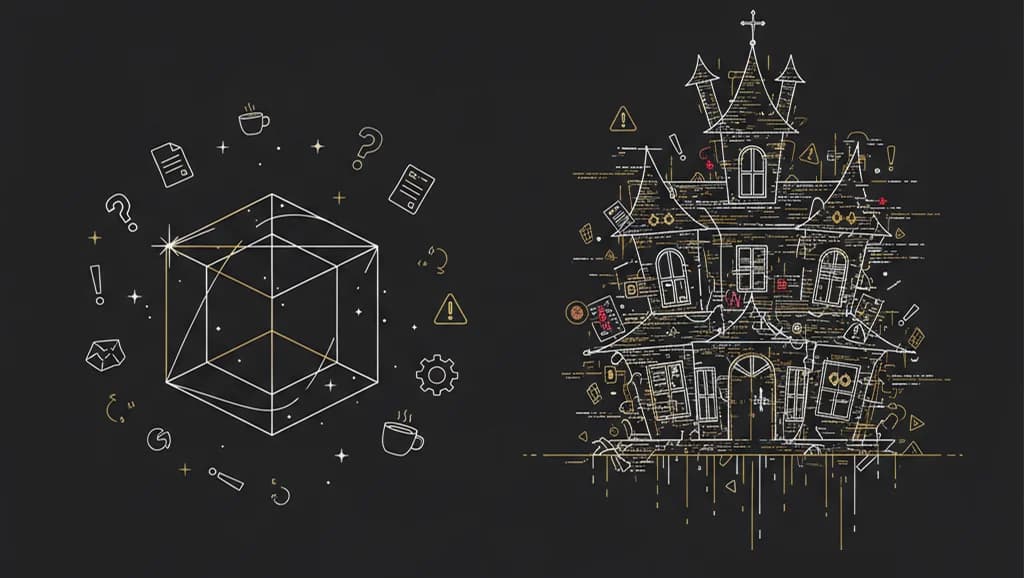
The Prototype Was Magic. The Product Is a Haunted House.
When we started auditing these products, the patterns became clear fast. Here's what's actually living inside most vibe-coded software:
- 50,000 lines of code where 30,000 do nothing. Functions calling functions calling functions that return nothing. Dead code everywhere. Nobody knows what's load-bearing and what's scaffolding the AI forgot to remove.
- Security that exists only as a concept. We reviewed one codebase where authentication was handled entirely client-side. Any user could give themselves admin access to the entire platform by editing a single browser value. Including customer data. The founder had no idea until we showed them. That app was processing payments.
- Infrastructure costs that scale with inefficiency, not users. One startup we audited had 47 API calls firing on initial page load. 19 were completely redundant. Their monthly cloud and API bill was $12,400 before they had 500 active users. After cleanup, it dropped to $2,900. That's not optimization. That's triage.
- Zero documentation. Zero tests. Zero institutional knowledge. The AI didn't write docs. Neither did the person prompting it. The only architecture map is in the founder's head, and it's wrong.
Here's the uncomfortable truth that underpins all of this: AI is incredible at generating output. It is terrible at owning consequences. And businesses don't fail because of output. They fail because of consequences. The edge case that corrupts user data. The security flaw that leaks payment info. The architectural decision that makes scaling impossible. AI doesn't think about those things. It doesn't think at all. It generates.
Thinking is your job. And if nobody on your team is doing that job, you don't have a product. You have a liability.
The Design Side Went Through the Same Bender
Here's what people aren't talking about enough, and as an agency with deep roots in both design and development, we feel obligated to say it: the design side of your product went through the exact same cycle.
Midjourney hero images. Figma Make layouts generated from a sentence. ChatGPT and Claude writing your UX copy. AI-generated brand systems shipped without a single designer asking "does this actually work?"
Here's what we keep finding:
- Brand systems with no internal logic. Colors with no system. Typography with no scale. Spacing based on whatever the AI felt like that day. It looks "good enough" on one screen and collapses on every other.
- UI that's all surface and no structure. Beautiful mockups with no information hierarchy, no accessibility considerations, no responsive logic, and no design tokens. It's a screenshot pretending to be a product.
- Frankenstein aesthetics. Midjourney generated the images. Figma Make generated the layouts. ChatGPT wrote half the copy. Claude wrote the other half. Three different tools, four different design languages, zero unification. Your app looks like it was designed by a committee of bots. Because it was.
You look at it and see "professional." We look at it and see a system that can't scale, can't be maintained, and doesn't solve your user's actual problem.
Same disease as the code. Different organ.
We Help Teams Vibe. And We Help Them Unvibe.
Here's where our philosophy lives, and why we think it matters.
At &Pixels, we are not in the business of telling people to stop using AI. That would be stupid. AI is one of the most powerful tools our industry has ever had access to. We use it ourselves. We integrate it into client products. We build AI automations that save our clients real time and real money.
But we use AI the way a skilled carpenter uses a nail gun. With precision, with intention, and with a clear understanding of what it can and cannot do. We don't hand the nail gun to someone who has never framed a wall and say "go build a house."
That distinction is the entire reason Unvibed exists.
When to vibe:
- Rapid prototyping and concept validation.
- Generating boilerplate and scaffolding that a skilled developer will review and refine.
- Accelerating design exploration with AI tools, then building a real system from the best outputs.
- Automating repetitive tasks that don't require judgment or nuance.
- Drafting copy, content, and documentation that a human will edit and finalize.
When to unvibe:
- When your AI-generated MVP needs to become a real product.
- When your codebase has grown beyond what anyone on your team can actually read.
- When your design system is a patchwork of AI outputs with no underlying logic.
- When your cloud costs are scaling with inefficiency, not users.
- When you're about to raise funding and your repo is a liability in due diligence.
- When you tried to hire a real engineer and they looked at your code and ghosted you.
The line between vibing and needing to unvibe is the line between drafting and shipping. Between prototype and product. Between "it works on my machine" and "it works for 100,000 users at 3 AM on a holiday weekend."
Most teams don't know where that line is. That's what we're here for.
AI Didn't Kill Developers. It Created Forensic Engineering.
We want to be very clear about this because the discourse around vibe coding tends to collapse into two camps: "AI is going to replace all developers" and "AI-generated code is garbage." Neither is true. Both are lazy.
The reality is more nuanced, and more interesting.
AI-generated code is probabilistic. It works most of the time, under most conditions, with most inputs. For a demo, that's fine. For a prototype, that's often fine. For a product that handles real users, real money, and real data, "most of the time" is a ticking bomb.
AI-generated design has the same problem. It can produce beautiful surfaces. It cannot produce systems. It can generate a screen that looks professional. It cannot generate a design language that scales across platforms, adapts to edge cases, and solves real user problems.
The missing ingredient in both cases is judgment. Human judgment. The kind that comes from experience, from understanding trade-offs, from knowing what questions to ask, and from having been burned enough times to see the fire before it starts.
That judgment is what &Pixels sells. Whether we're building something new or fixing something broken, the value we bring is the ability to make the decisions AI can't.
Dry January Is Not Engineering Discipline
One thing we've been watching closely: some founders are starting to sense the hangover. They're pulling back slightly. Reviewing AI output more carefully. Maybe adding a linting step. Maybe hiring a junior developer to "oversee" the AI code.
They think they're sobering up. They're not. They're doing Dry January.
Dry January is when you stop drinking for a month, feel virtuous about it, and go right back to your old habits by February. In this context, it's a founder who panics after a production outage, slows down on prompting for a week, then quietly goes right back to shipping unreviewed AI output because the board wants a new feature by Friday.
Then comes Damp February. "We'll still use AI for everything, but we'll be more careful." You glance at the code before you merge. You call it rigor.
It's not rigor. It's switching from tequila to wine and calling it moderation.
Real sobriety means something different. It means having humans on your team who can actually read, write, debug, and architect the systems your business depends on.
We call it sober engineering. The deliberate, human-led practice of using AI as an accelerant while maintaining the architectural rigor, testing discipline, and design systems thinking that make software actually work. Sober engineering isn't slower. It's just not reckless.
That's the foundation of everything we do at &Pixels, and it's the entire reason Unvibed exists.
Why We Created Unvibed as Its Own Brand
We could have just added "AI code rescue" as a service line on the &Pixels website. We thought about it. But the more cleanup work we did, the more we realized this problem deserved its own identity.
Here's why.
The founders who need Unvibed are often in a specific emotional state. They're stressed. They're embarrassed. They built something they were proud of, and now they're finding out it's held together with duct tape and hallucinated logic. The last thing they want is to feel judged.
Unvibed meets them where they are. The branding is direct. The tone is honest. The message is simple: the party is over, the hangover is here, and we're the ones who fix it. No judgment. Just the cleanup.
&Pixels is the builder. Unvibed is the fixer. Same team. Same humans. Same standards. Different entry point depending on what you need.
If you're starting something new and want it built right from day one, that's &Pixels. We'll be your dedicated design and engineering team. We'll move fast. We'll work through your task queue based on the hours you invest each cycle. And we'll be true partners in your product's success.
If you already shipped something and it's falling apart, that's Unvibed. We'll audit it, stabilize it, or rebuild it. We'll be honest about what's salvageable and what's not. And we'll get you to a place where real engineers and designers can maintain what you have.
Either way, you get the same thing: humans who type, humans who think, and humans who build things that survive.
The People You Fired Are the Ones You Need
One of the things we wrote about on the Unvibed blog is how vibe coding didn't kill designers and developers. It changed what the job looks like. And it raised the bar on what "skilled" means.
Designers in the post-vibe era aren't just pushing pixels. They're being asked to:
- Audit and rebuild AI-generated design systems that have no underlying logic.
- Build component libraries and design tokens that actually scale, because Figma Make outputs and Midjourney assets can't self-organize.
- Make critical UX decisions that require empathy, user research, and judgment. Things AI cannot do.
- Create the system behind the surface. The part AI always skips.
Developers in the post-vibe era aren't just writing code. They're being asked to:
- Forensically debug codebases no human wrote. Whether it came from Claude, Cursor, Lovable, Bolt, or Base44, this is a new and uniquely brutal skill.
- Refactor AI-generated spaghetti into maintainable architecture. Translating "robot stream of consciousness" into actual software.
- Make judgment calls about security, scalability, and infrastructure that require real experience.
- Write the tests, docs, and guardrails that AI never bothers with.
At &Pixels, our team has adapted to this reality. Our UX designers are fluent in AI-generated design triage. Our senior engineers can read a Cursor-generated or Lovable-generated codebase and tell you in an hour what's real and what's a ghost. Our architects can take a vibe-coded MVP and draw you a roadmap from "barely holding together" to "ready to scale."
This isn't a pivot for us. It's an expansion. We still build from scratch. We still ship new products. We still move fast and partner deeply. But now we also meet clients where they are, even if where they are is a codebase that's on fire.
The Invoice Is Here. And It's Compounding.
Whether you're a client of ours or not, here's what we believe every team should know right now.
- AI is a tool, not a team member.
Use it to accelerate. Use it to explore. Use it to automate the tedious stuff. Do not use it to replace the judgment, experience, and accountability of skilled humans. - The prototype is not the product.
Vibe coding can get you to an MVP fast. Celebrate that. Then immediately start planning the transition from "prompted" to "engineered." The longer you wait, the more expensive it gets. We've seen it go from a manageable $130k stabilization to a $500k full rewrite simply because the team waited too long. - Design systems matter more than ever.
When AI can generate a hundred screens in an afternoon, the differentiator isn't the screens. It's the system behind them. Invest in design tokens, component libraries, and real information architecture. It's the only way to scale. - Hire for judgment, not speed.
The value of a senior designer or engineer was never their typing speed. It's their ability to make decisions. About trade-offs, edge cases, user behavior, technical debt, and long-term maintainability. That value just went up. - Know when to vibe and when to unvibe.
There's a time for speed and experimentation, and there's a time for rigor and architecture. The teams that win will be the ones who know which mode they're in and act accordingly. - Understand the real math.
You saved $80k by skipping the senior engineer and the real designer. Now your cleanup costs $130k minimum. One of our audit clients was burning $12,400/month on cloud and API costs with fewer than 500 users. After cleanup: $2,900. Another had authentication so weak that any user could give themselves admin access to the entire platform. That app was processing payments. The cost of not having skilled humans isn't theoretical. It's compounding daily.
What Comes Next
The AI hangover is real, and it's going to get worse before it gets better. More vibe-coded products will hit production. More will break. More founders will realize that the $80k they saved on engineering is now a six-figure cleanup bill.
But on the other side of the hangover, something good is emerging. Teams are getting smarter about how they use AI. The bar for what "skilled" means is rising. The demand for real craftsmanship in design and engineering is coming back, not in spite of AI but because of it.
AI lowered the barrier to starting. It did not lower the cost of finishing.
The real competitive advantage in 2026 won't be prompting faster. It will be understanding deeper.
At &Pixels, we're here for all of it. The building. The fixing. The partnership. The long game. We've been at this for 30 combined years across design and development. We'll be here for the next 30.
If you're starting something new, let's build it right from the start.
If you're sitting on something that's already breaking, let's fix it before the next outage.
Either way, we don't judge. We just get to work.
Start a project with &Pixels → andpixels.com
Get your code sober with Unvibed → unvibed.com
&Pixels. Turning ideas into working digital experiences. And when the vibes run out, we've got Unvibed.
Ship Happens in your inbox
Notes from the build trenches. No spam, we send only when we have something good.